YouTube's AI Moderation and Its False Positives
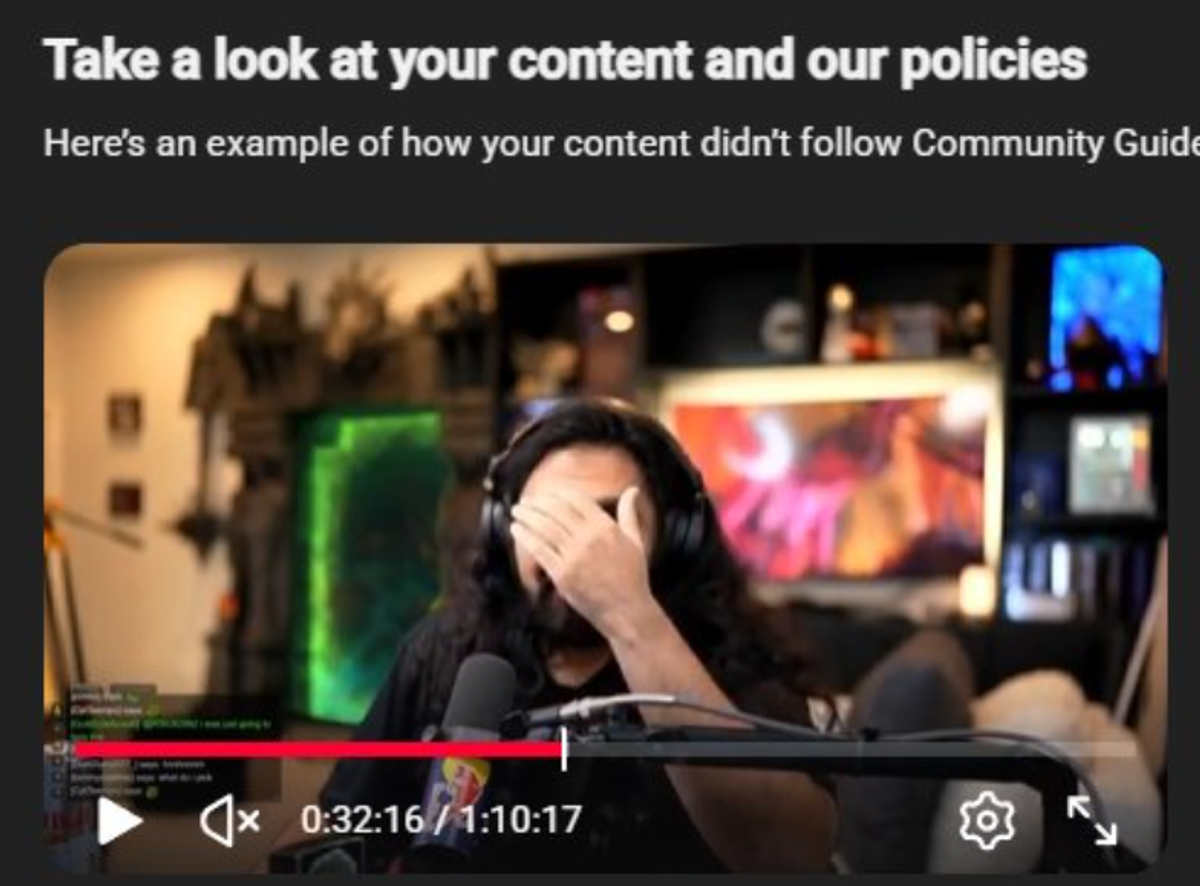
Another big streamer, Esfand, just received a strike on his YouTube channel, and the tweet shows that it was an AI false positive. Nothing about the screenshot is a violation of YouTube’s ToS.
YouTube runs on automated moderation. With hundreds of hours of video uploaded every minute, no human team could review it all, so the platform leans heavily on AI systems to flag and remove content that appears to break the rules. Most of the time, that scale is invisible and it works. But when the automation gets it wrong, the consequences fall hard on creators who did nothing wrong, and a growing pile of well-documented cases shows just how often "wrong" happens.
A quick note on scope. This article focuses only on cases where the mistake is well established, in many instances acknowledged by YouTube itself. AI moderation catching genuinely rule-breaking content is the system working as intended. The problem is the false positives: legitimate creators and videos swept up by a system that misreads context.
The core problem: context is hard for machines
Automated systems are good at pattern-matching and bad at nuance. YouTube's own guidance acknowledges that its detection algorithms, while increasingly sophisticated, still struggle with context, which is why flagged content is supposed to be routed to human reviewers. In practice, that human backstop does not always catch the error before a creator's video, or entire channel, is taken down.
The failure modes are surprisingly varied. A system trained to detect nudity or "provocative" content can flag someone who is fully clothed because of a pose, a camera angle, or a thumbnail it misreads. A system trained to detect violence can flag content with no violence at all. And a system trained to detect spam or "inauthentic" content can mistake a real, original creator for a bot farm. Each of these has happened, and been documented, in the past year.
Documented cases where YouTube admitted the mistake
Some of the strongest examples are the ones where YouTube itself reversed course and apologized.
In late 2025, a creator known as Norse797 had their 108,000-subscriber channel terminated for "spam and deceptive practices" despite having no prior warnings. After nearly a year of fighting, and being told at one point that "the original decision stands," the channel was finally reinstated. TeamYouTube's message was unusually direct: the team confirmed the channel "did not violate our Community Guidelines," calling the termination "a mistake on our end" and saying "we're truly sorry."
That was not isolated. Search Engine Journal documented a wave of creators hit with sudden terminations for "spam, deceptive practices and scams," followed by appeal rejections that arrived so fast and so uniformly that creators suspected automation was rejecting them too. Among the confirmed errors: the true crime channel The Dark Archive was removed and later restored after tagging TeamYouTube publicly, and streamer ProkoTV was restricted from live streaming over a spam warning YouTube later acknowledged was an error. The outlet also cited a creator whose 100,000-plus subscriber channel was banned over a comment they had written on a different account at age 13, a ban YouTube ultimately admitted was a mistake.
The pattern predates this. Back in 2024, YouTube publicly apologized after a system misfire incorrectly flagged a batch of channels for "Spam & Deceptive Practices" and removed them, acknowledging on X that it was aware of an issue "causing some channels to be incorrectly flagged for spam and removed."
Legitimate content, wrongly flagged
Beyond channel terminations, individual videos get caught too, often in ways that would be comical if livelihoods were not on the line.
Tech tutorials have been a repeated casualty. As reported by Ars Technica and covered widely, popular videos explaining Windows 11 workarounds were flagged as "dangerous" or "harmful" and removed, with some appeals rejected in under a minute. YouTube later reinstated the videos and denied automation was responsible, but creators described unusually fast flagging and uniform, templated responses that pointed squarely at an automated system.
The misfires reach into genuinely harmless territory. One documented case involved a pet video of a bunny and a parrot sharing a red pepper, flagged by the automated system as "violent or graphic content." There is no violence in a rabbit eating a vegetable, which is exactly the point: the system does not understand what it is looking at.
Artists have been hit hard too. A large group of stop-motion and animation creators, including the channel Tiny Grandma, were demonetized or banned after YouTube flagged their handmade work as "inauthentic," apparently swept up in enforcement aimed at AI-generated spam despite using no AI at all. Many had to make public statements just to get YouTube's attention.
This connects directly to the situation streamers describe: a creator sitting fully clothed, doing nothing against the rules, suddenly hit with a violation notice because an algorithm misjudged a frame. When the same system that flags a rabbit for "violence" is judging a livestreamer, false positives are not a surprise. They are a structural feature of moderation at this scale.
The pattern behind the failures
Two things stand out. First, escalation on X often works better than the official appeal process. A striking number of these reversals happened only after the creator's public post gained traction, which suggests the normal appeals pipeline is itself heavily automated and prone to rubber-stamping the original error. Second, YouTube maintains that only a "small percentage" of enforcement actions are reversed and that it has "not identified any widespread issues." Both can be true at once: the error rate can be small as a percentage and still represent an enormous number of wrongly punished creators, given YouTube's scale. For a creator whose income depends on the platform, "small percentage" is cold comfort when you are the false positive.
Protecting the content you care about
If there is a practical lesson here, it is that no single platform is a safe permanent home for the content you value. Videos vanish, channels get flagged, and clips disappear while creators fight to get them back, sometimes for months.
That is exactly why building your own library matters. With VODey, you can pull VODs from both Twitch and YouTube into one place and organize them into playlists you control. For streamers especially, this is a practical tool: you can curate a playlist of clips or past broadcasts to react to live on stream, line up VODs in the order you want to cover them, and keep your reaction material organized in advance instead of scrambling to find it mid-stream.
Want a reaction lineup ready to go? Sign up for VODey and build playlists of your favorite Twitch and YouTube VODs to watch and react to on stream.